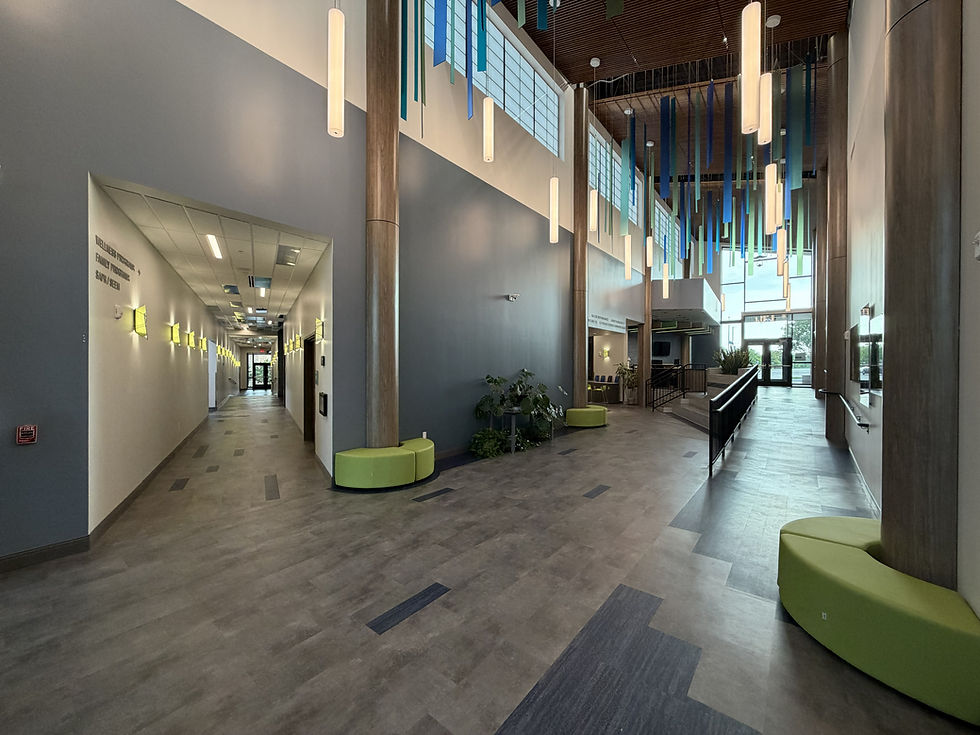
Sandia Base Elementary School LEEDv4 Silver Certified

Updated: Oct 9
More than 449 tons of carbon dioxide. That's the annual emissions reduction associated with the energy performance and renewable energy design of the new Sandia Base Elementary School—equivalent to the carbon sequestered by more than 6,700 trees each year.

For Albuquerque Public Schools (APS), that performance is part of a much larger
investment in the future of its students. The new Sandia Base Elementary School, designed by Roma Architecture and constructed by HB Construction, replaces the existing school with a modern learning environment designed for 576 students and 80 full-time staff.
The 88,645-square-foot school achieved LEED v4 Silver certification in September 2026, continuing APS's commitment to a minimum LEED Silver standard for its projects.
Designing for People and Performance
LEED is often associated with a certification level or a collection of points, but at its core, the rating system is about addressing the environmental impacts of buildings while creating healthier, more efficient places for people to use.
For a school, that matters in very practical ways. A building that uses less energy can reduce its long-term environmental impact and operating costs. Reducing water consumption helps conserve a resource that is particularly important in New Mexico. Daylight and connections to the outdoors can improve the experience of the students and staff who spend their days in the building.
At Sandia Base Elementary, these principles are reflected throughout the project.
The school's energy performance is one of its most significant accomplishments. The project achieved 53.9% energy savings through its LEED performance calculations, while its renewable energy system is estimated to generate approximately 238,533 kWh annually.
The environmental significance of that performance becomes clearer when translated into carbon impact. Compared with a typical school design, the project's energy performance and renewable energy design are expected to reduce carbon dioxide emissions by more than 449 tons annually—equivalent to the carbon sequestered by more than 6,700 trees each year.
Water conservation is another important part of the story. The project achieves an estimated 25.75% reduction in indoor water use, saving approximately 234,785 gallons annually, while outdoor water use is reduced by 66%, or approximately 131,146 gallons each year.
For a school in Albuquerque, these savings are particularly meaningful. Water-efficient fixtures and landscape strategies reduce demand on a limited resource, while also reducing the amount of water the school needs to treat, pump, and use over the life of the building.
A Learning Environment Connected to the Outdoors
The sustainability strategies at Sandia Base Elementary extend beyond the building's resource consumption.
The design provides ample daylight throughout the school, along with a central courtyard and multiple outdoor learning spaces. A robust landscape design incorporates water-efficient strategies while creating opportunities for students to interact with the outdoors.
These elements connect directly to the broader goals of LEED: sustainable buildings are not only about reducing environmental impacts, but also about creating spaces that support the people who occupy them.
The project also diverted 40.01% of construction waste, or more than 209 tons of material, from the landfill.
Sustainability Within Constraints
Sandia Base Elementary also demonstrates how sustainability strategies can be adapted to a project's specific circumstances.
Located within the Kirtland Air Force Base boundary, the project had limited opportunities to pursue some LEED location and transportation credits. Rather than allowing those limitations to define the project's sustainability goals, the team focused on areas where the building could have the greatest measurable impact—including energy, renewable energy, water conservation, daylight, and resource efficiency.
The result is a project that demonstrates that high-performance outcomes are possible even when a site presents limitations within the LEED rating system.
Verdacity's Role
Verdacity served as the project's LEED and Sustainability Consultant, supporting APS and the design team from early design through construction.
Our work began with establishing the project's LEED scorecard and coordinating sustainability and LEED design criteria with the project team. Verdacity worked closely with Roma Architecture to incorporate LEED strategies into the design and evaluate project milestones for compliance.
Verdacity also performed daylight and energy modeling in collaboration with the project's consulting engineers, helping the team evaluate building performance. We developed project specifications, coordinated LEED documentation, and managed the information required for certification and submission.
During construction, Verdacity continued to oversee sustainability-related activities and support the project's LEED requirements through completion.
Building the Future of Sustainable Design
Sandia Base Elementary demonstrates that LEED certification can be about much more than achieving a rating.
By reducing energy and water consumption, incorporating renewable energy, managing construction resources, and creating a school filled with daylight and connections to the outdoors, the project brings together environmental performance and the everyday experience of its students and staff.
For Verdacity, the project is a strong example of how sustainability goals can translate into measurable environmental benefits and better places to learn.
Congratulations to Albuquerque Public Schools, Roma Architecture, HB Construction, and the entire project team on achieving LEED v4 Silver certification for Sandia Base Elementary School.
Inspired to help create what's next?
We're growing our team. Verdacity is currently hiring for opportunities to work alongside architects, engineers, contractors, and owners to advance high-performance, sustainable design across New Mexico and beyond. If you're passionate about building sustainability and want to be part of the work, explore our current opportunities and consider joining the Verdacity team.