
Sustainability Isn’t a Major. It’s a Lens.

By Huang Banh
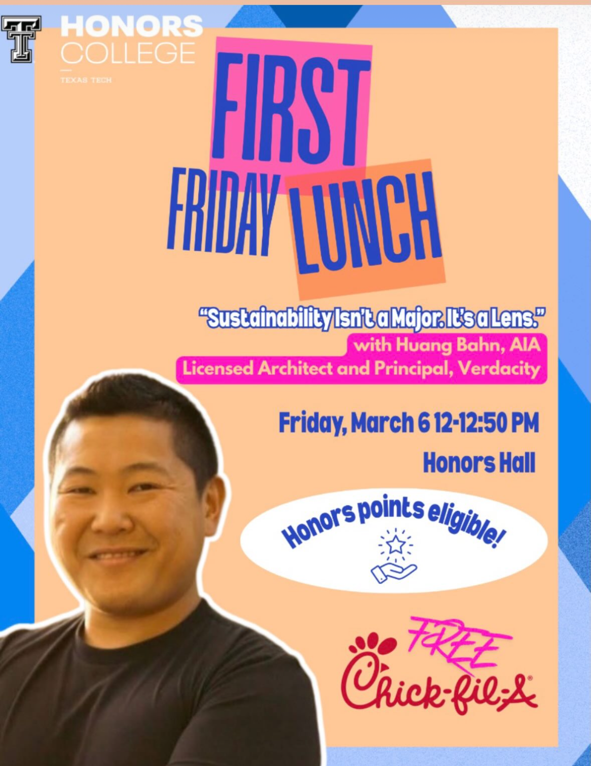
Recently I had the opportunity to speak with students at Texas Tech University about sustainability and careers in the built environment. Conversations like these are always energizing because they remind me how many different paths there are for people who care about the future of our communities and our planet.
During the talk, I shared an idea that has shaped much of my own career:
Sustainability isn’t a major. It’s a lens.
It’s a way of approaching problems that considers three things at the same time:
People, Planet, and Profit. Often referred to as the triple bottom line, this framework helps guide better decisions—whether you're designing a building, managing an organization, or shaping policy.
What matters isn’t your job title. What matters is the perspective you bring to your work.

Your Values Are Not Your Job Title
At the start of the presentation, I asked students to choose a value that resonated with them: creativity, curiosity, stability, recognition, helping others, financial security, or innovation.
What stood out wasn’t what they chose—it was what they didn’t choose.
Almost no one chose a job title.
That moment highlights some
thing important: your values are not your profession. Your profession is simply the vehicle through which you pursue those values.
For me, architecture became that vehicle. I didn’t choose architecture simply because I wanted to design buildings. I chose it because buildings shape human experience, public health, energy use, and community resilience.
Architecture provided a system through which I could apply the values that mattered to me.
Sustainability in Practice
It’s easy to talk about sustainability in theory. It becomes much more meaningful when you see how it plays out in real projects.
During the presentation, I shared two examples that illustrate how the People–Planet–Profit lens works in practice.
Making Energy Visible: The Cool Box Challenge

One of the most memorable demonstrations of building performance comes from the Cool Box Challenge, an effort from many partners in our community and the AIA NM Committee on The Environment, an educational project developed to make energy efficiency visible.
Two small structures are built side by side—one to basic code, one to high-performance standards. Each contains the same amount of ice. Then the sun does the teaching.
Over time, the difference becomes undeniable.

In Northern New Mexico, this idea was expanded into the construction of three habitable tiny homes by students and community volunteers:
One built to 1950s construction standards
One built to modern energy code
One built to high-efficiency performance standards
After the demonstration, the lower-performing homes were upgraded and placed into service as housing for residents supported by Esperanza Shelter, which assists survivors of domestic violence.
What began as an educational experiment became safe, dignified housing.
Designing Schools Around Students
Another example comes from Arroyo del Oso Elementary School in Albuquerque.
Designing healthy classrooms begins with asking: What makes a space a good place to learn?
Students at Texas Tech identified daylight, comfortable temperatures, quiet environments, and access to fresh air and views.
The design team at Arroyo del Oso identified similar priorities and this understanding to shape:
Balanced daylighting with reduced glare
Skylights to evenly distribute natural light
Improved acoustics through coordinated materials and systems
Clean air strategies that isolate chemical sources

These choices support student well-being and performance while delivering impressive environmental results: nearly an 87% reduction in energy costs supported by efficient systems and on-site solar power.
A school isn’t just a building. It’s a place where experiences are formed and futures begin.
A Lens for Every Profession
The most important takeaway for students was that sustainability thinking isn’t limited to architects or engineers.
A teacher can advocate for healthier learning environments.
A business leader can prioritize long-term operational efficiency.
A software developer can reduce energy demand through efficient computing.
A policymaker can support resilient infrastructure.
In every field, there are opportunities to make decisions that improve outcomes for people, the planet, and the economy.
Sustainability isn’t a specialized role, It's a way of thinking—and the earlier that mindset develops, the greater impact it can have.
Join Us in This Work
If Verdacity’s mission resonates with you and you want to contribute to healthier, more sustainable communities, we invite you to explore our open roles.


